Interferometry Basics
The key to understanding how interferometry works is understanding the wave nature of light. The above figure shows a light source emitting waves of light. These waves are continually expanding out from the light source in all directions, just like ripples in a pond. The crests of the waves are represented by lines in the diagram. The wavelength of the light is the distance between the peaks. A particular wavelength of light corresponds to a particular color, from red (longest) to blue (shortest).
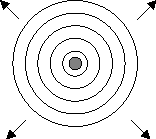
Most sources do not just produce one wavelength. White light, such as that from the sun, contains essentially all the wavelengths that the human eye is sensitive to. To get a clean interference pattern in most interferometers, we need to use just one wavelength (monochromatic light). Also we need to have all the crests of the waves lined up, a situation known as coherence. If you throw a stone into a pond, you get a coherent pattern of ripples. If you throw in a handful of gravel, you get incoherent ripples.
The interferometer needs a source of coherent, monochromatic light . The most useful source of such light is the laser .